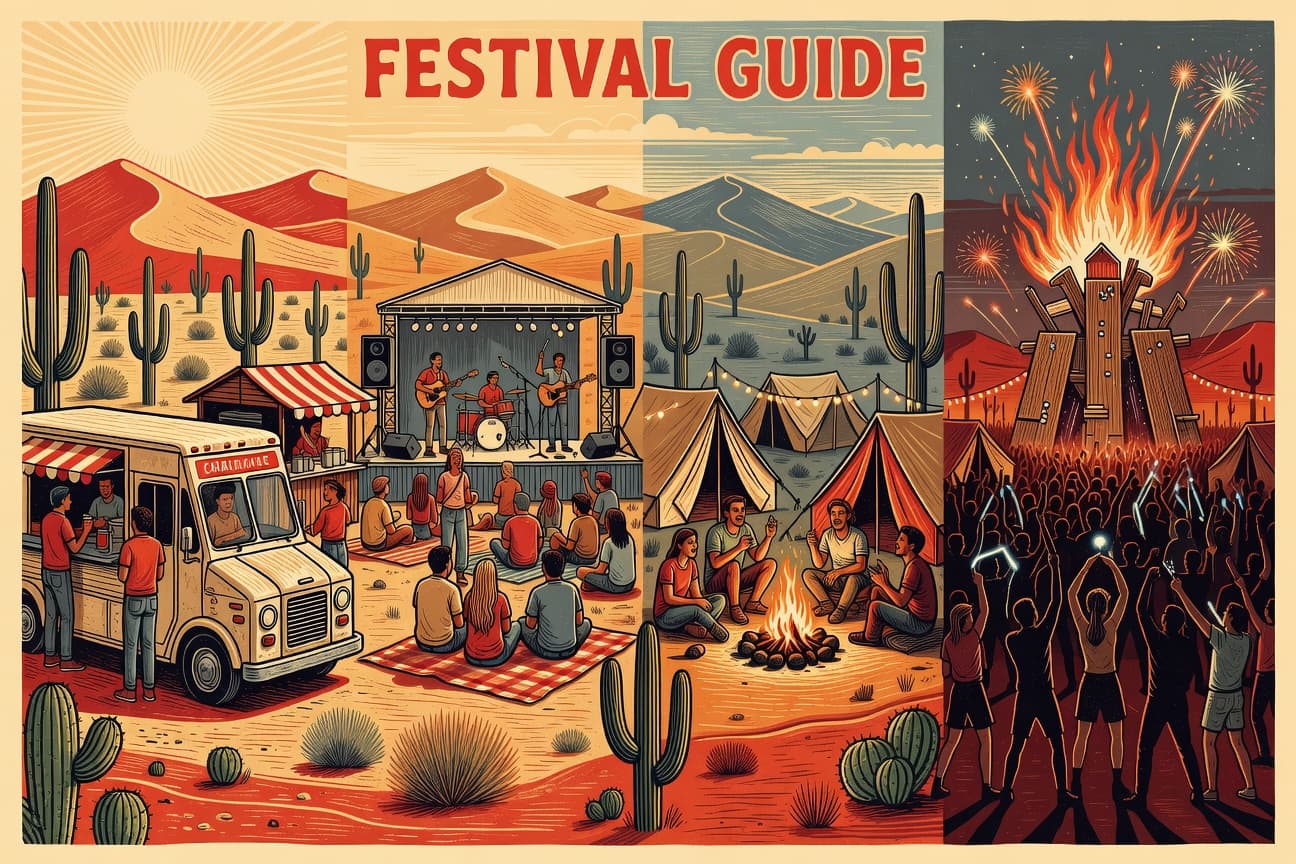
You want to go to Coachella. Or Burning Man. Or Mardi Gras. Or something with "festival" in the name that your friends keep posting about. The Instagram version looks incredible: flower crowns, sunset silhouettes, matching outfits, and everyone glowing. The reality is more complicated. Not bad -- often genuinely life-changing -- but different from what social media prepares you for in ways that nobody warns you about until you're standing in a field at 2 AM wondering what happened to your shoes.
This guide is a progression system. Five tiers over roughly two years, each one building skills and tolerance for the next. Think of it like altitude training. You don't summit Everest on your first climb. You acclimate. Each tier introduces new variables -- heat, crowds, camping, communal living, sensory overload, and the social dynamics of thousands of strangers sharing a temporary world -- so that by the time you hit the deep end, nothing is a complete shock.
Skip tiers at your own risk. The person who goes straight from zero festival experience to Burning Man is the person crying in a porta-potty at 2 AM on Tuesday night with six days still to go.
Tier 1: Day Festivals
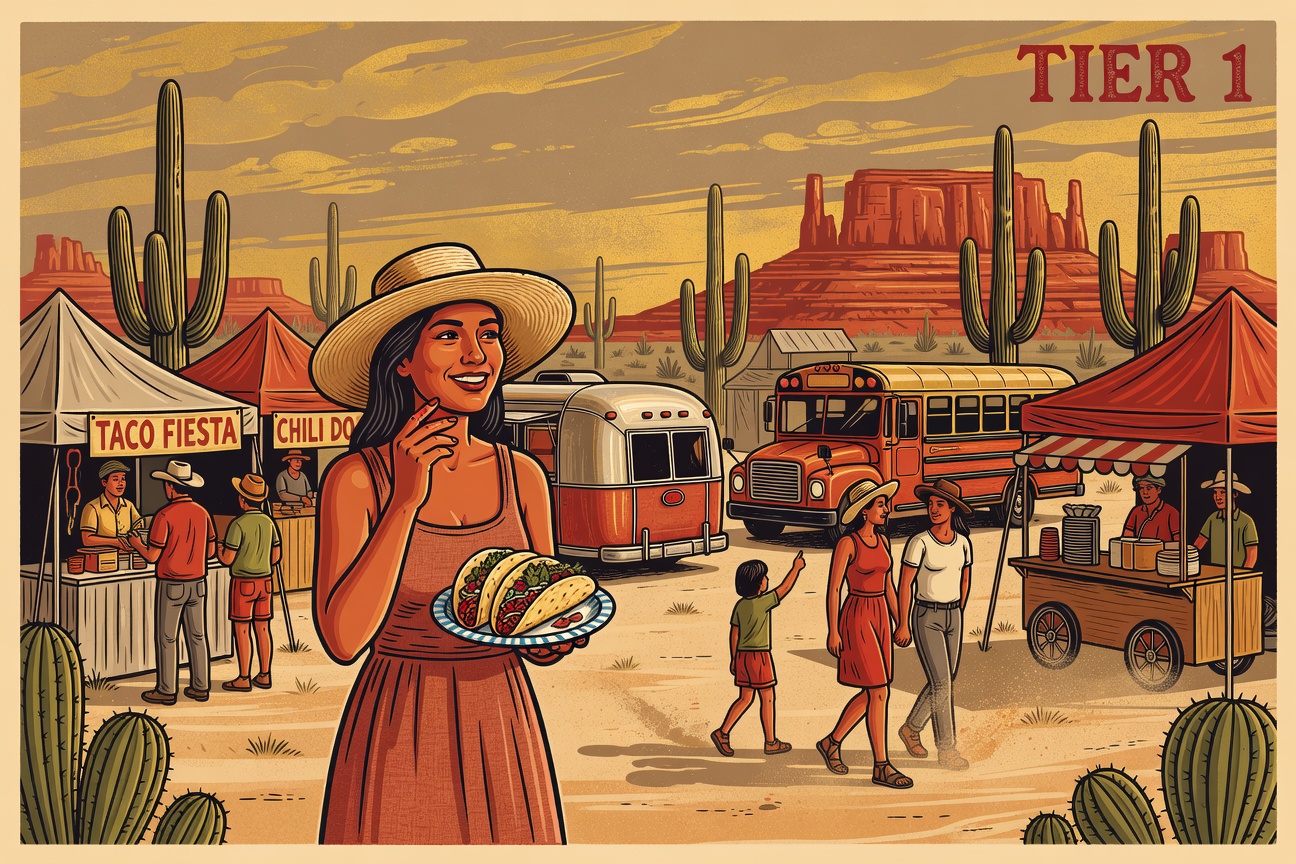
What it is: You drive somewhere in the morning, walk around for 4-8 hours, eat things, maybe see some live music or entertainment, and drive home to sleep in your own bed. The training wheels of festival life.
What you're learning: How your body handles extended time outdoors in heat. How to navigate a crowd. How to pace yourself with food and water. How to wear the right shoes (you will learn this the hard way -- everyone does).
What Actually Happens
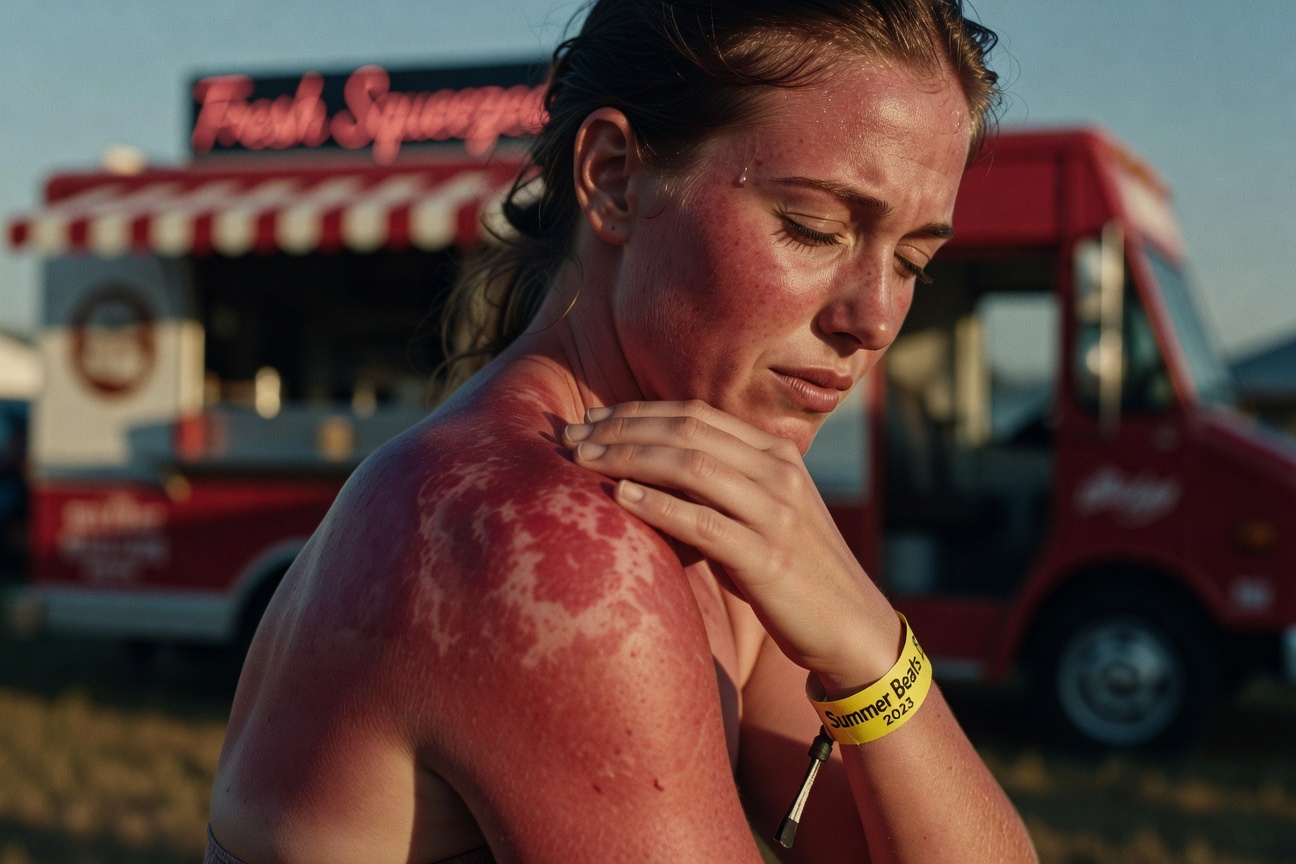
You show up thinking it will be casual. Three hours later you've walked 12,000 steps, spent $60 on food you didn't plan to buy, your feet hurt because you wore sandals instead of sneakers, and you have a sunburn on the back of your neck because you forgot to reapply sunscreen after the first hour. Welcome to festival lesson number one: the sun and the pavement are more exhausting than the event itself.
Arizona day festivals in spring are the perfect training ground because the heat is the real adversary. A March festival in Phoenix can surprise you with 105F, which turns a fun food walk into a survival exercise if you didn't hydrate proactively. If you can handle a full day at an outdoor Arizona event in April without leaving early, overheating, or feeling miserable, you've built the physical foundation for everything that comes after.
Budget creep is real. You tell yourself you're going to spend $20 on food. Then you see the birria tacos. Then the elote. Then the churros. Then the $8 lemonade. By sunset you've spent $80 and you can't explain where it went. Set a cash limit before you arrive. Leave your credit card in the car. Bring $60-80 in cash and when it's gone, you're done buying things. This discipline matters more at Tiers 3-5 where overspending means running out of resources when you actually need them.
The Shoe Conversation
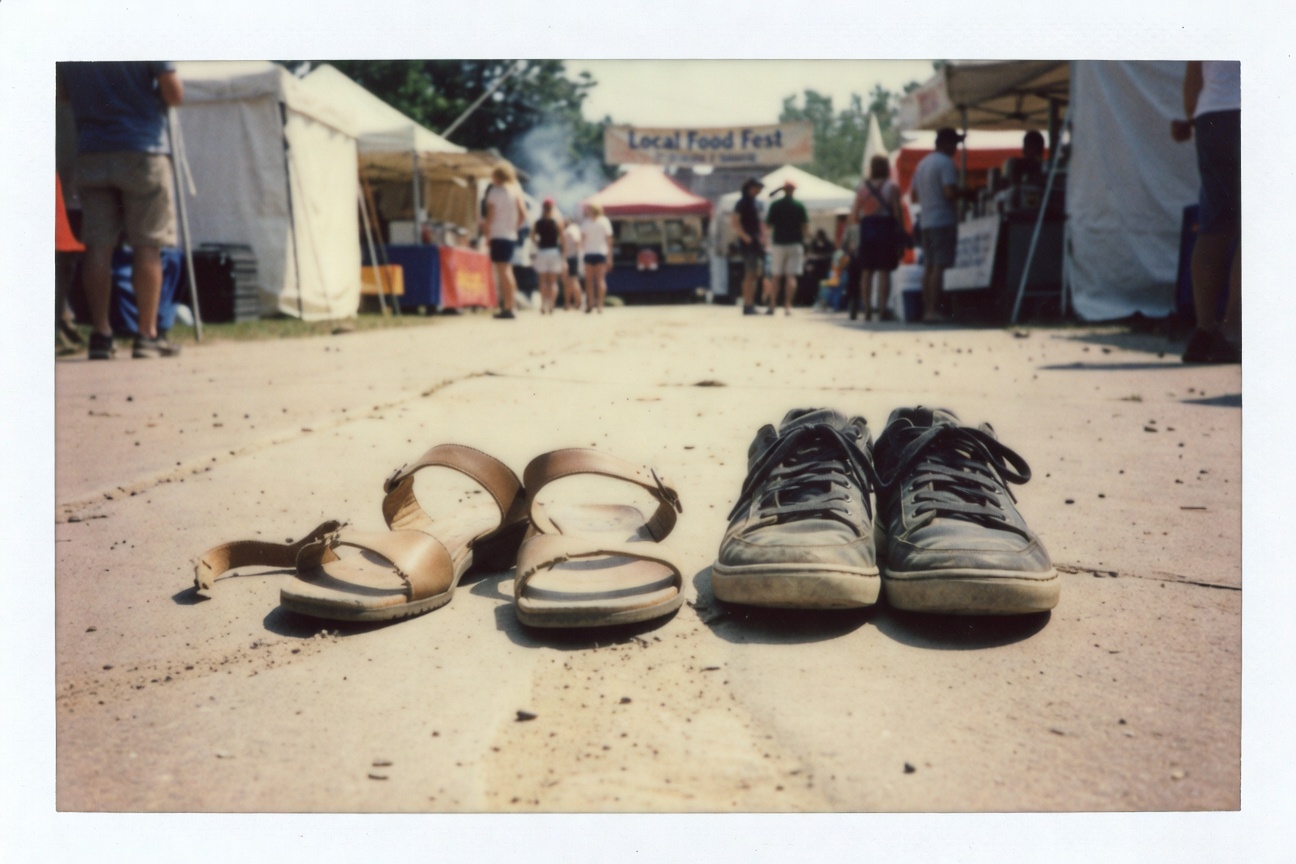
This deserves its own section because it's the most universal first-timer mistake. Your cute boots, your new sandals, your platform sneakers -- leave them home. You're going to walk 15,000-20,000 steps on concrete, asphalt, gravel, and grass. By hour four, you will feel every step. Wear broken-in sneakers with real arch support. Running shoes are ideal. This isn't about fashion, it's about whether you can still walk by 6 PM. Every single tier of this guide comes back to the same truth: comfortable shoes over cute shoes, every time, no exceptions.
Arizona / SoCal Options
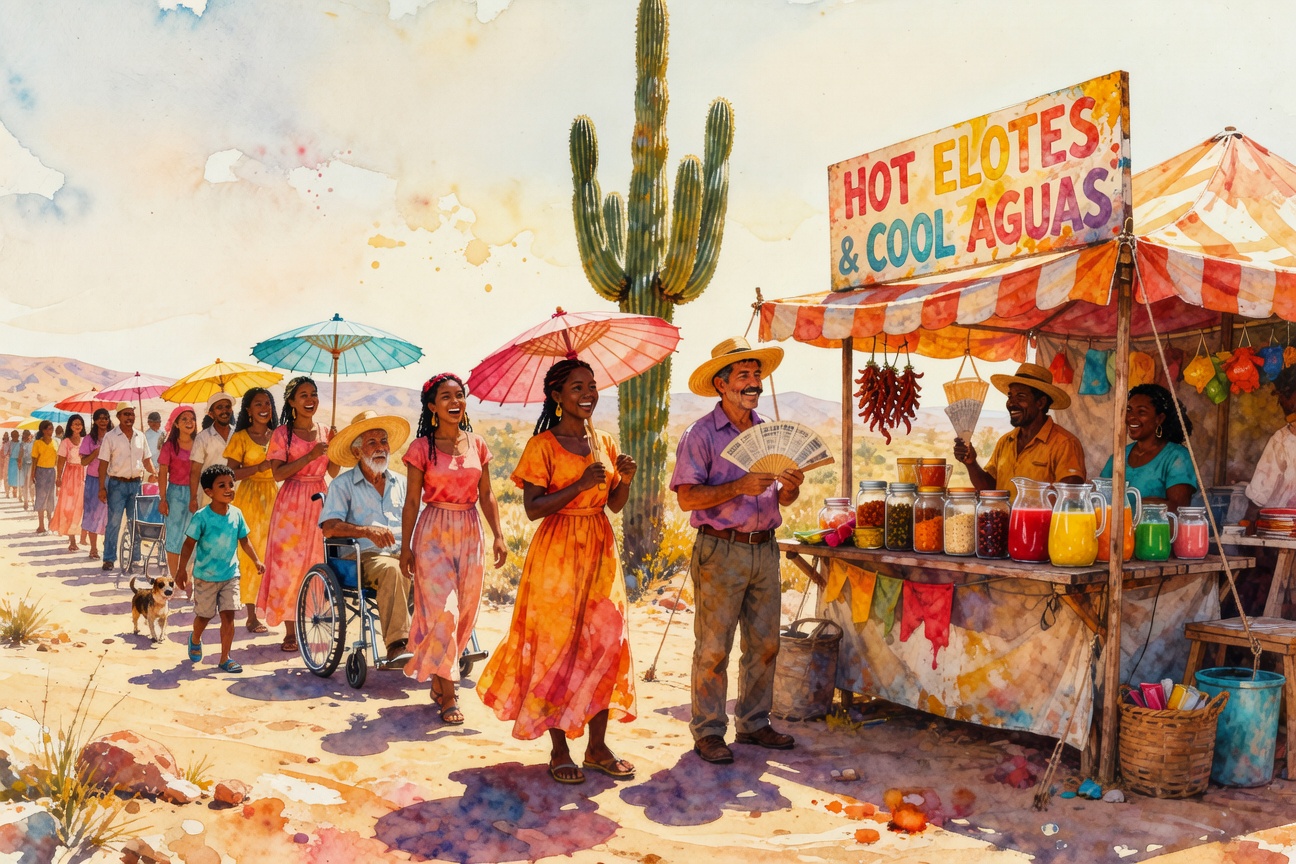
Foodieland (Phoenix, AZ) -- Food festival with 100+ street food vendors on a fairground. Pure eating and walking, with some live music. Low intensity, high reward. Watch the weather though: March dates can land on a 105F day, which turns "fun food walk" into "medical tent risk." Check the forecast two days before and bail if it's over 100F. There's no shame in skipping. They do multiple events per year.
First Friday (Phoenix, monthly, free) -- Art walk on Roosevelt Row. Food trucks, galleries, live music, and street performers from 6-10 PM. This is the lowest possible stakes: it's free, it's walkable, it's in the city, and you can leave whenever you want. Perfect for someone who's never done any kind of outdoor event.
Chandler Ostrich Festival (March, ~$15 admission) -- Local fair energy with rides, carnival food, live music, and yes, ostrich races. Absurd and fun. The crowd is families and locals. If you can spend a full afternoon here in March heat without wanting to leave, you have your Tier 1 baseline.
VIVA PHX (April, various venues in downtown Phoenix) -- Multi-venue music discovery festival. Small stages, walkable between venues, a good introduction to navigating between acts and choosing what to see. Teaches you to make real-time decisions about where to be, which becomes critical at larger festivals where you physically cannot see everything.
Distance from Chandler: All of these are within 30 minutes. Drive home in your own AC. Sleep in your own bed.
You're Ready for Tier 2 When
- You've done at least 2 full-day outdoor events without leaving early from heat or exhaustion
- You've figured out your hydration rhythm (drinking water before you're thirsty, not after)
- You've dialed in sunscreen application (every 90 minutes, including the back of your neck and ears)
- You've found your go-to festival shoes
- You've stood in a crowd for 45+ minutes watching something without feeling claustrophobic
- You've survived a day where the plan changed and you rolled with it instead of stressing
Tier 2: Multi-Day Urban Festivals
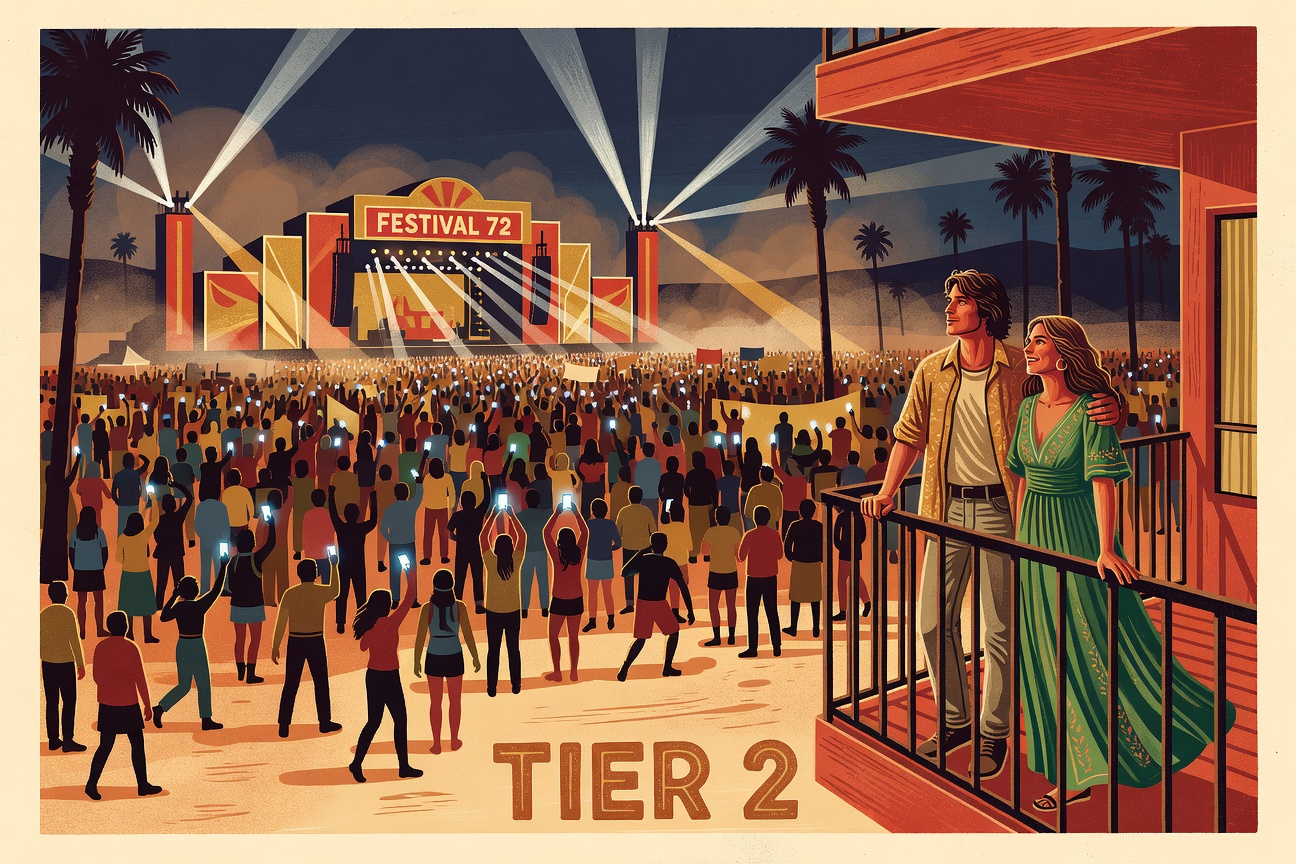
What it is: Multiple consecutive days of music, events, or experiences, but you sleep in a hotel. You have air conditioning, a real shower, a door that locks, and a bed with sheets. This is the sweet spot where you experience festival intensity with full recovery infrastructure, and honestly, a lot of people find this is their forever tier. There's nothing wrong with that.
What you're learning: How to sustain energy across multiple days. How to recover overnight and do it again. How to handle large-scale crowds (50,000-100,000 people). How to deal with cumulative sensory overload -- not just one loud afternoon, but three days of constant noise, lights, heat, and human contact.
The Cumulative Fatigue Problem
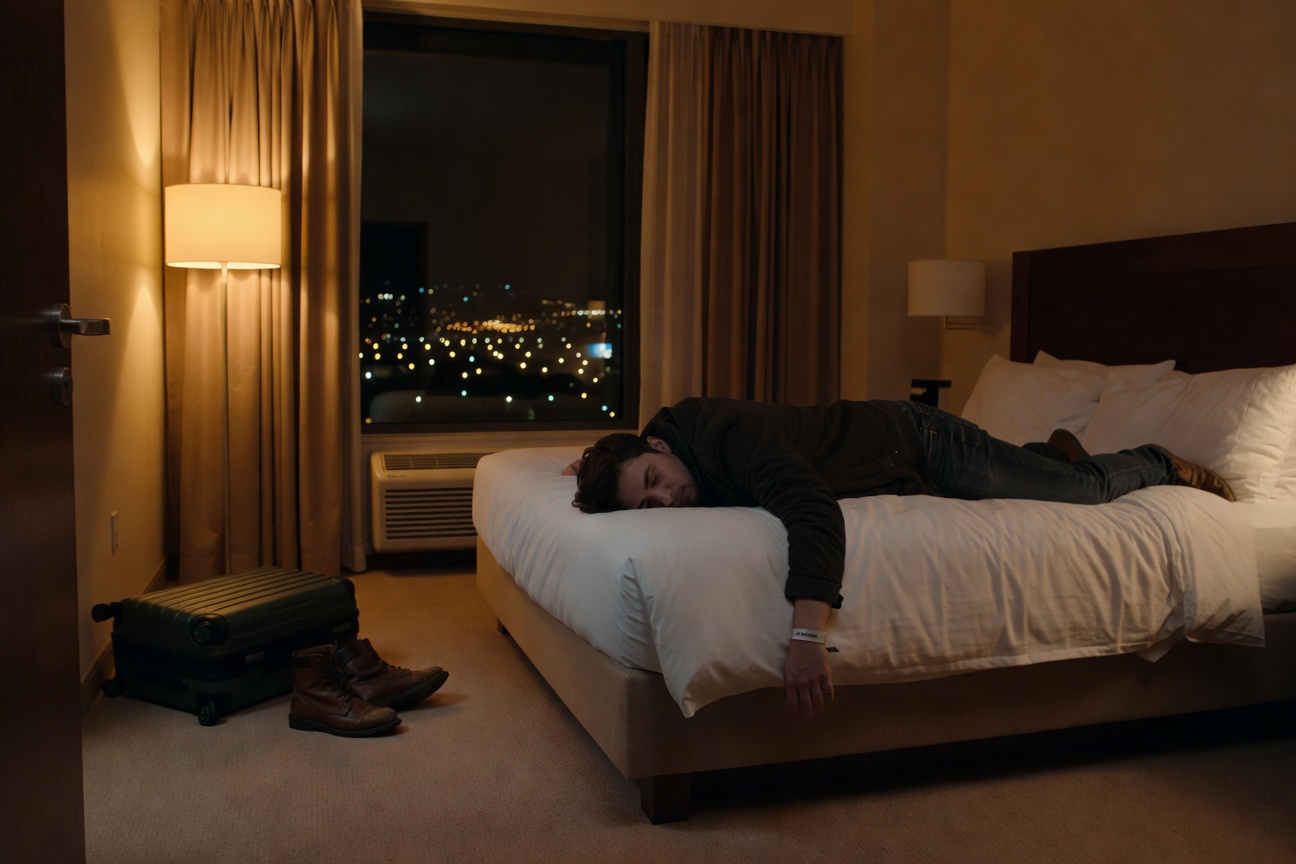
Day 1 of a multi-day festival feels incredible. Everything is new. You have energy. The music is amazing. You stay out late because you feel invincible.
Day 2, your feet hurt. Your voice is hoarse from yesterday. You slept five hours because you were too wired to fall asleep before 2 AM. The sun hits the same way but you feel it twice as much. You push through because you don't want to miss anything.
Day 3, you're running on adrenaline, coffee, and stubbornness. Your body is tired. Your brain is foggy. You've eaten nothing but festival food for 48 hours and your stomach knows it. The music is still great but you're watching from further back because you don't have the energy to push to the front.
The fix is counterintuitive: rest is a strategy, not a weakness. Skip an afternoon set to nap in your hotel. Eat a real meal at a restaurant instead of another $15 festival burger. Take a long shower and sit in the AC for an hour. The people who have the best time at multi-day festivals are the people who pace themselves like a marathon, not a sprint. You don't have to see every set. You have to be functional for the ones that matter.
Earplugs: The Non-Negotiable
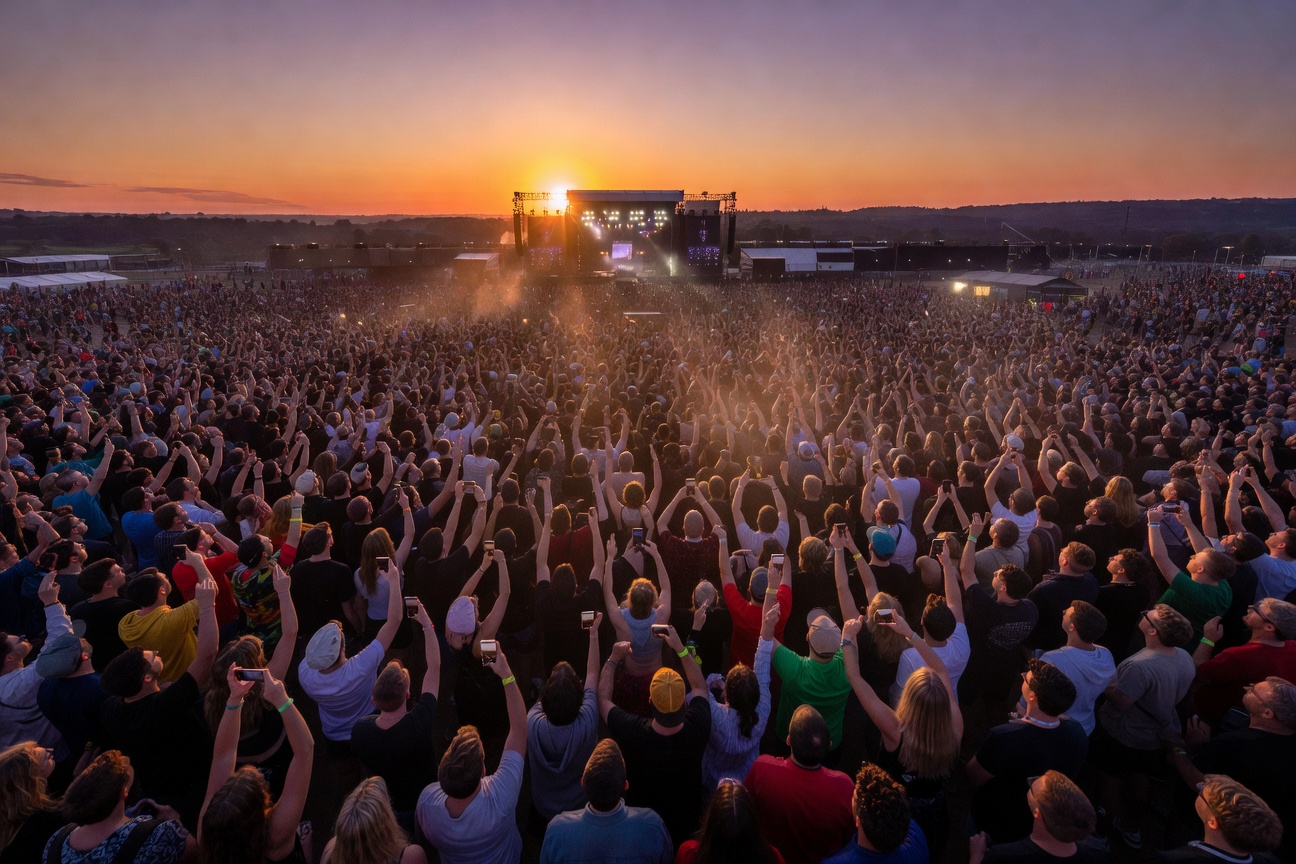
Concert-level sound is 100-120 decibels. Sustained exposure above 85 dB causes permanent hearing damage. Tinnitus -- a constant ringing in your ears -- is irreversible and cumulative. Every loud show you attend without ear protection adds to the total.
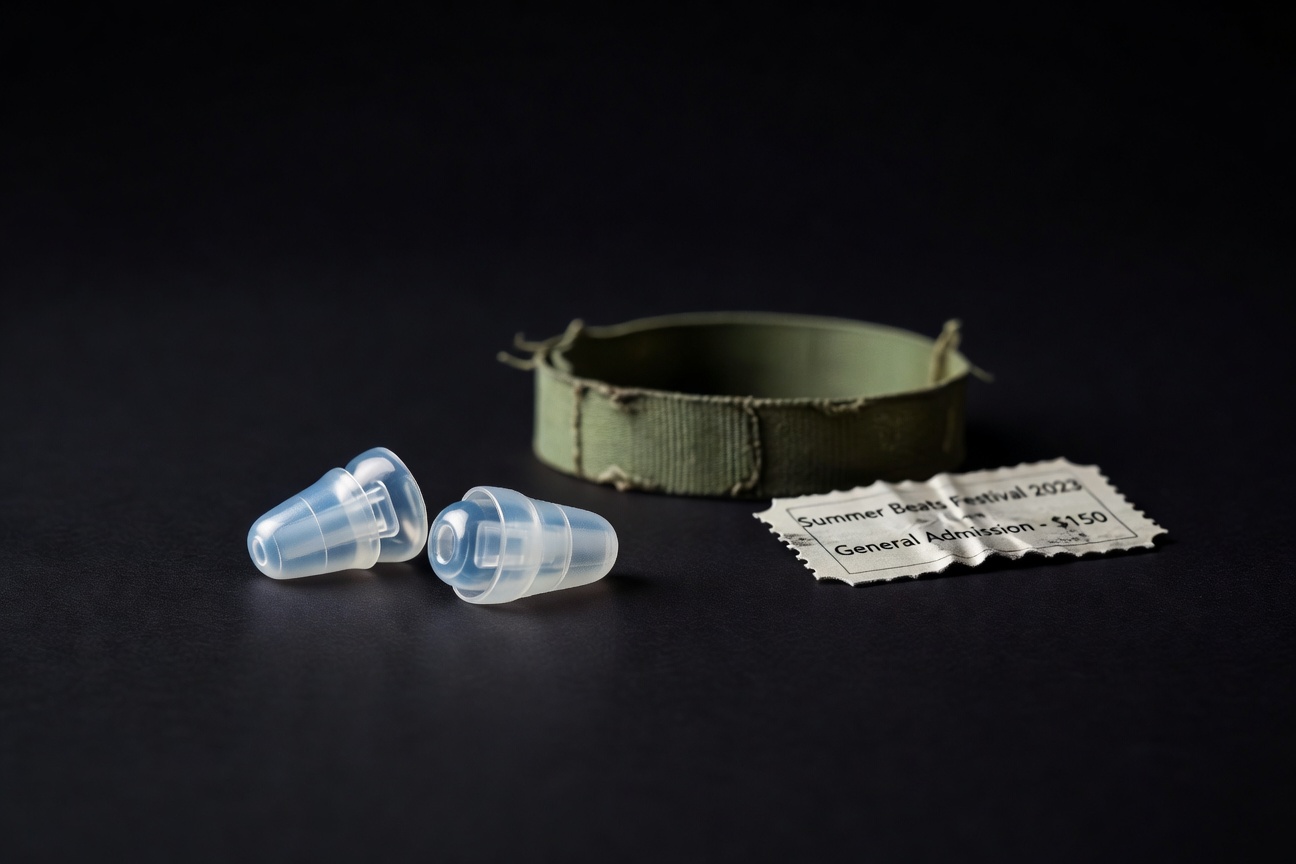
Do not use the foam earplugs from the pharmacy. They muffle everything and make music sound like it's underwater. Get proper concert earplugs: Loop Experience ($30), Eargasm ($35), or Etymotic (~$20). These reduce volume by 15-20 dB while preserving sound quality. The music sounds the same, just quieter. You can still have conversations. And at 2 AM when you're trying to sleep in a hotel with your ears still buzzing, you'll understand why this was the best $30 you ever spent.
You will feel self-conscious putting them in the first time. Do it anyway. Look around at any festival and you'll see hundreds of people wearing them. The people not wearing them are the ones who'll be asking "what?" at every dinner conversation by age 40.
The Hotel Is Your Sanctuary
Underestimate this at your peril. After 10 hours in a crowd, in the heat, in the noise, in the chaos -- walking into a quiet, air-conditioned hotel room with a real shower is a psychological reset. It's the difference between "I can do this again tomorrow" and "I never want to see another human being." When you graduate to camping festivals in Tier 3, this sanctuary disappears. That's why Tier 2 matters: it teaches you what festival life feels like while giving you the recovery environment to process it.
Options
Innings Festival (Tempe, AZ, February) -- Two-day festival at Tempe Beach Park combining music and baseball. Past headliners include Pearl Jam, Foo Fighters, Weezer. February weather in Tempe is perfect: 75F and sunny. Hotels everywhere in the Tempe/Scottsdale corridor. 20 minutes from Chandler. This is the ideal Tier 2 entry for Arizona residents because you can drive to the venue in the morning and be home in your own bed by midnight if the hotel feels unnecessary. Tickets: ~$200-250 for a 2-day GA pass.
Outside Lands (San Francisco, CA, August) -- Three days in Golden Gate Park. Excellent music, plus dedicated food and wine areas curated by SF restaurants. The weather is the opposite of Arizona: San Francisco in August is 60-65F, foggy, and windy. Bring layers. Stay in a hotel in the city and take transit to the park. Very manageable for a first multi-day experience. Tickets: ~$450-500 GA. Flight from Phoenix: ~$150-200 round trip on Southwest.
Lollapalooza (Chicago, IL, August) -- Four days in Grant Park, downtown Chicago. This is the biggest jump in scale at Tier 2: 100,000+ daily attendance. You'll take the L train to your hotel afterward. The crowd density teaches you what a major festival actually feels like -- the press of bodies, the noise, the energy -- while you still get to decompress in a hotel every night. Tickets: ~$350-400 for 4-day GA.
EDC Las Vegas (May) -- This is a borderline Tier 2/Tier 4 experience. Technically you sleep in a Vegas hotel, but the festival runs from dusk to dawn (7 PM to 5 AM) with 170,000 people. The schedule alone is a Tier 4 challenge. 5 hours from Chandler. Include it here only because the hotel sleeping option makes it accessible, but understand that the scale and hours are extreme.
You're Ready for Tier 3 When
- You've survived a 3-day festival without wanting to go home early
- You've handled being separated from your group in a crowd and found each other again without panicking
- You own proper earplugs and use them automatically
- You've experienced at least one full day of total sensory overload and recovered overnight to do it again
- You've seen things at festivals that surprised you -- substances being used openly, people in minimal clothing, public intoxication, strangers being very friendly -- and kept your composure
- You understand your own limits: when to push through tiredness and when to go back to the hotel
Tier 3: Camping Festivals
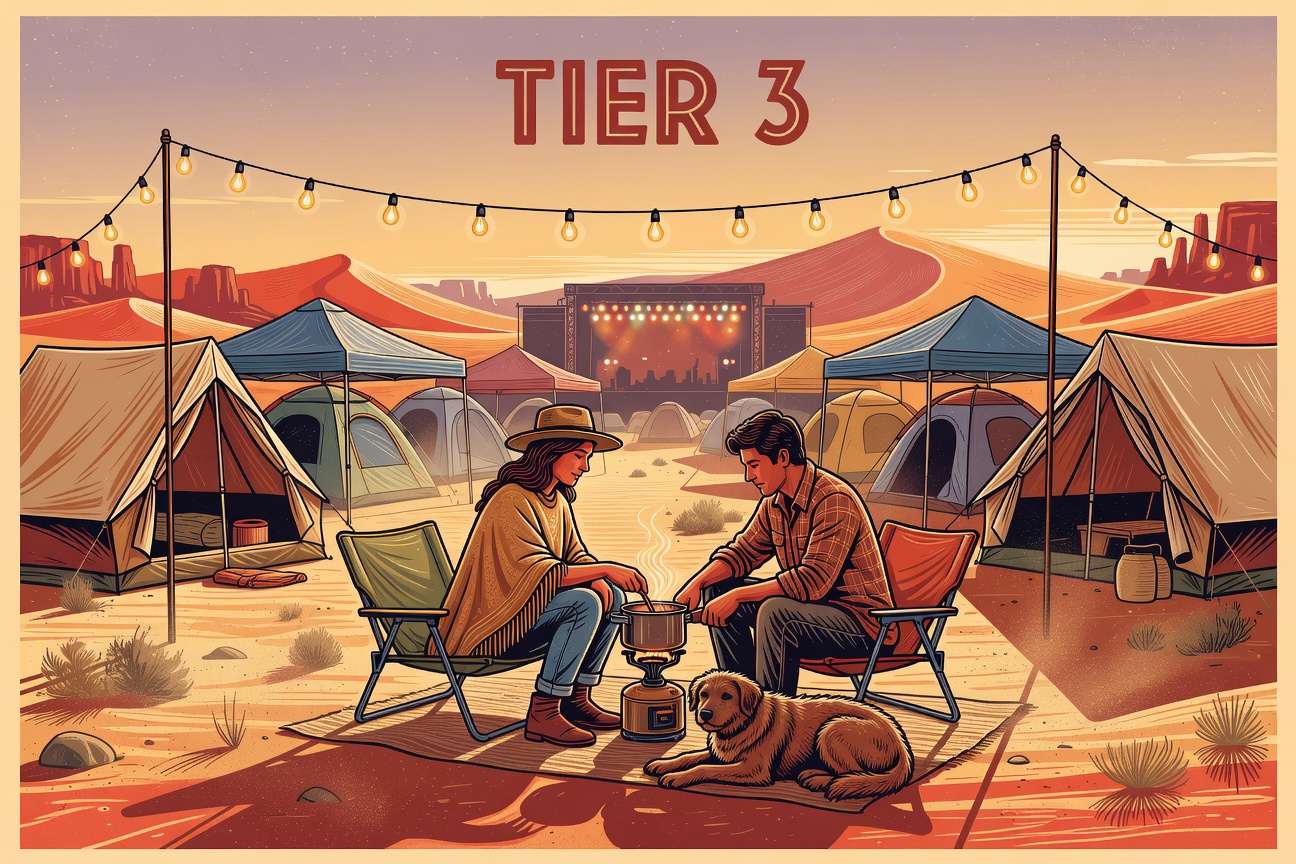
What it is: You sleep in a tent at the festival grounds. No hotel. No air conditioning. No door that locks. No privacy beyond a sheet of nylon between you and the world. This is where festival culture gets real, and where most people discover whether they actually want to go deeper or whether Tier 2 is their sweet spot.
What you're learning: How to camp at a music event. How to sleep surrounded by noise. How to share communal facilities (bathrooms, showers, water) with thousands of strangers. How to maintain basic hygiene without a real bathroom. How to function on 4-5 hours of sleep for multiple nights. How to be OK when your personal space shrinks to the dimensions of a $40 tent from Walmart.
The Instagram vs. Reality Section
This is the tier where the social media fantasy collides head-on with physical reality. Every point below is something that first-timers say they wish someone had told them before they showed up.
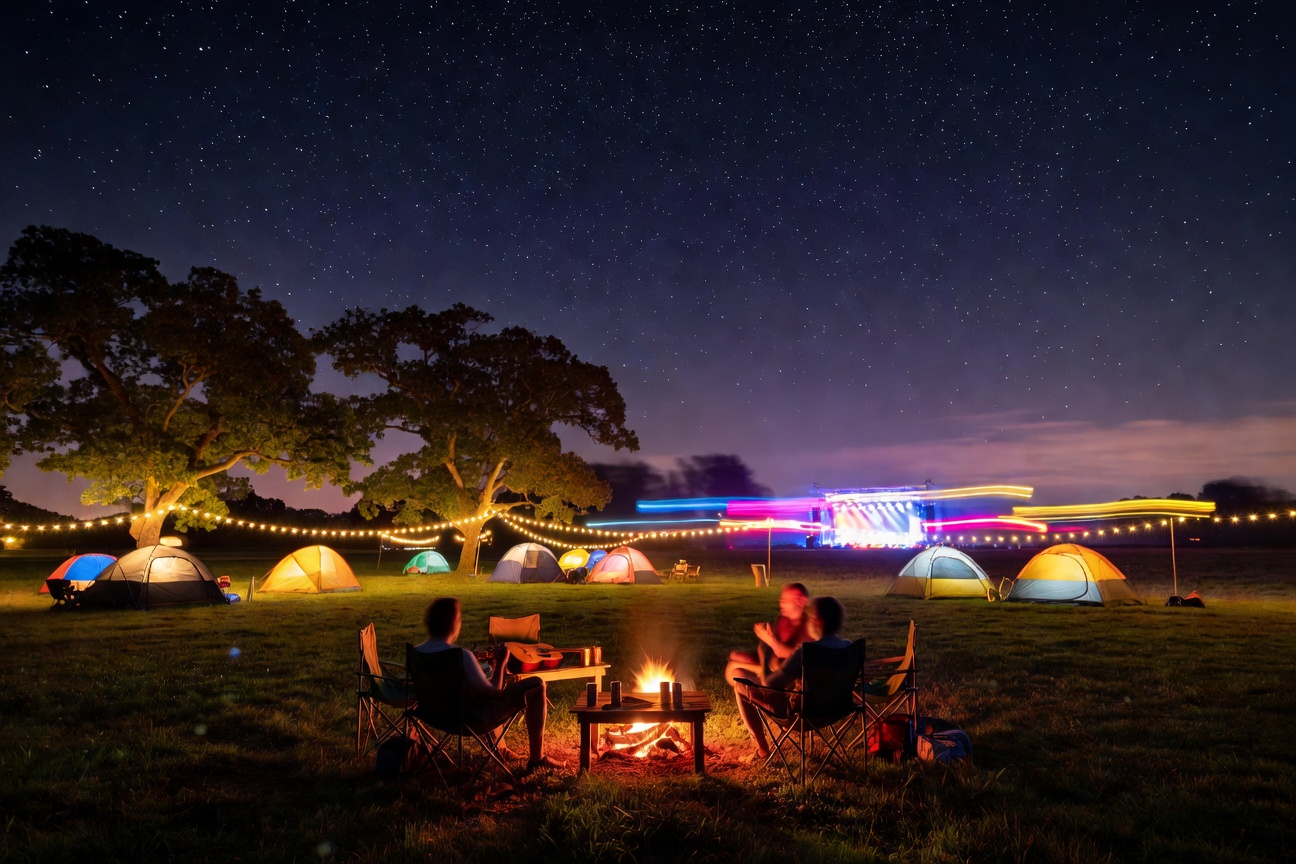
Sleeping. Your tent is a nylon shell. It has the sound insulation of a paper bag. The people in the tent next to yours are four feet away. You will hear everything they do. Everything. Their conversations at 1 AM about whether they should get back together. Their alarm at 7 AM that they sleep through but you don't. Their sex at 3 AM that is neither quiet nor brief. Their friend who comes back wasted at 4 AM and can't find the tent zipper for five minutes. This is not a rare occurrence. This is every single night. Earplugs and an eye mask are not optional equipment -- they are the difference between sleeping and not sleeping. Accept now that you will average 4-5 hours of interrupted sleep per night, not the 8 hours you get at home. Plan your days accordingly.
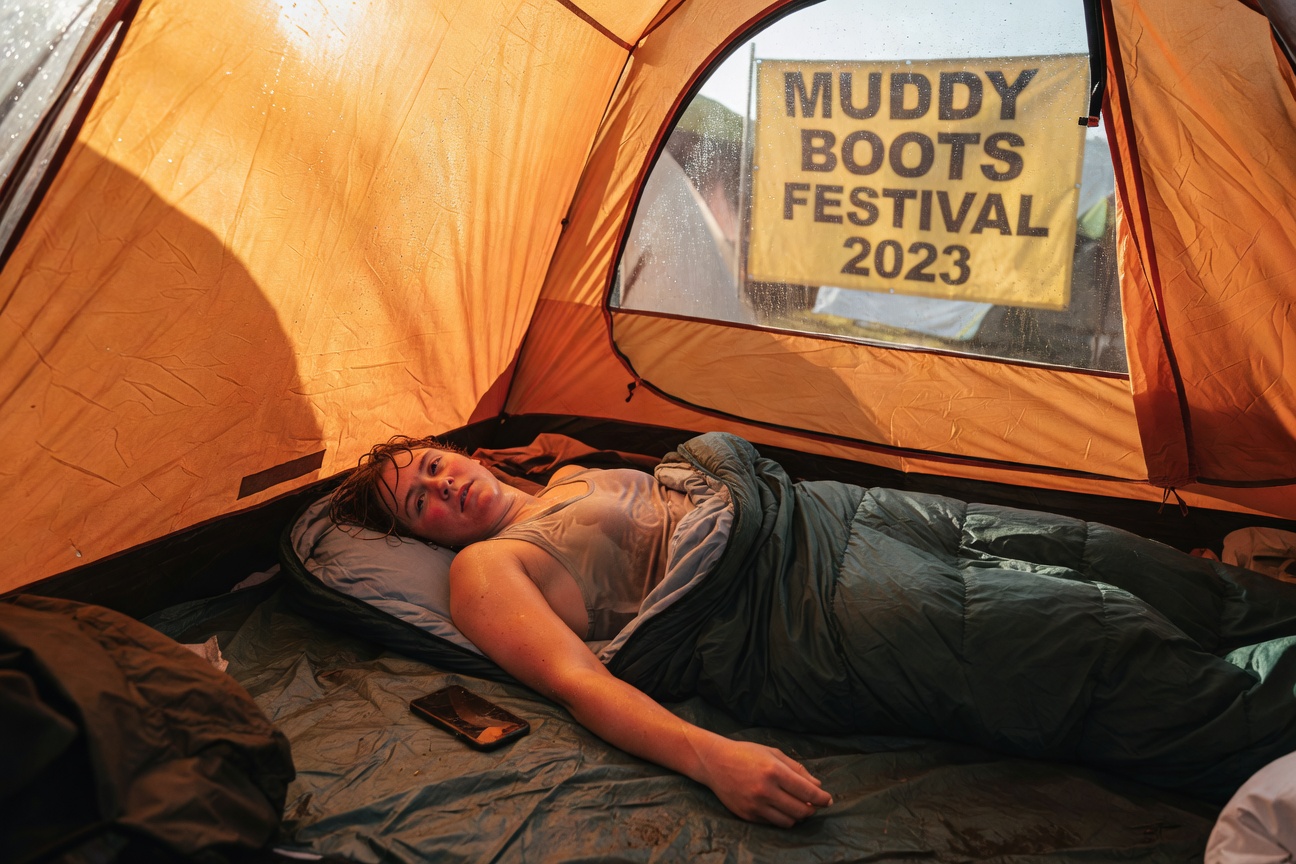
Morning heat. Here's the thing about tents that nobody mentions: they're greenhouses. Even in mild 70F weather, a closed tent in direct sunlight hits 95-100F inside by 8 AM. You will wake up drenched in sweat, disoriented, and desperate to get out. In desert locations like Indio (Stagecoach, Coachella), morning temps inside an unshaded tent can exceed 110F. A shade canopy or EZ-Up over your tent is not a luxury -- it's the single most important comfort item you will bring. It can add an hour or two of tolerable sleeping conditions in the morning. Bring one, or accept that your day starts at sunrise whether you planned it or not.
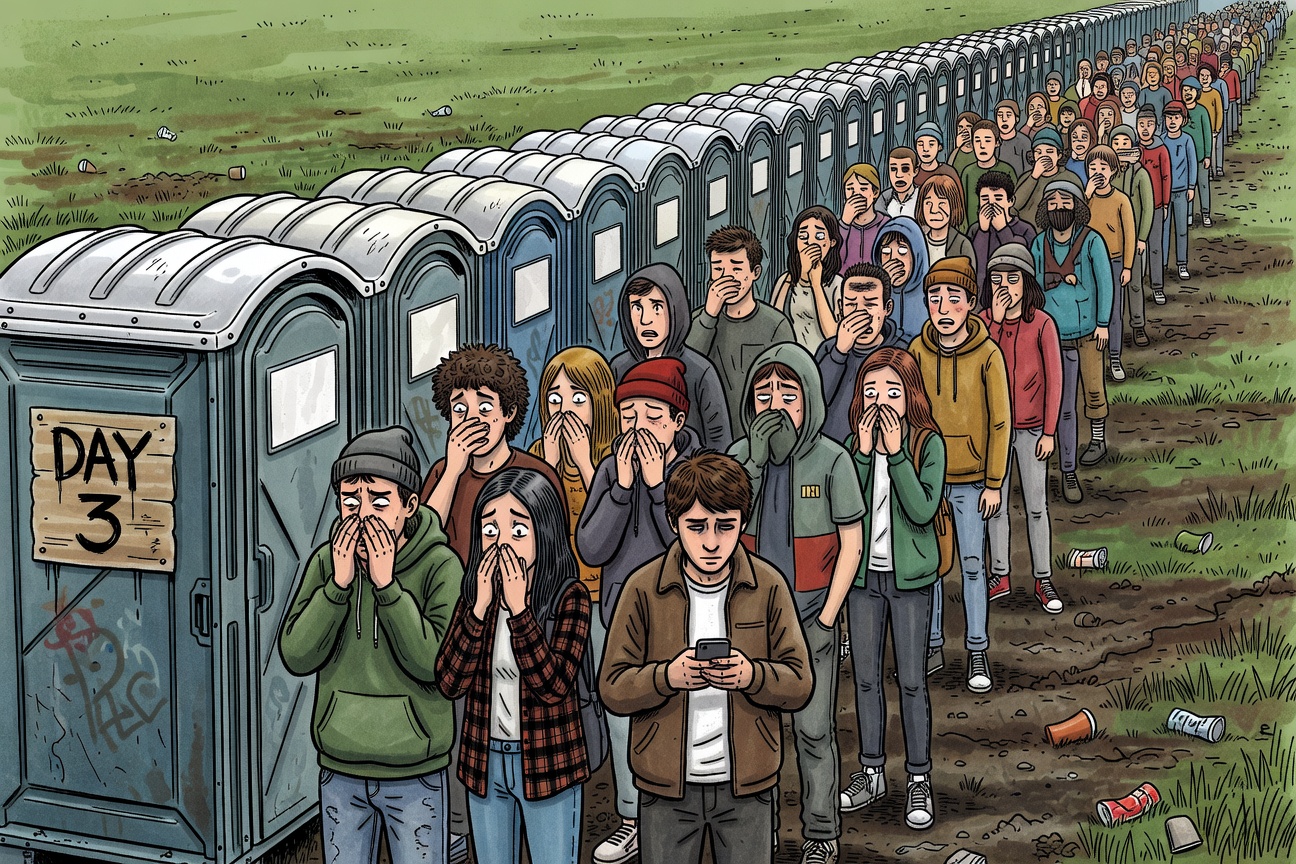
Bathrooms. Porta-potties. Rows and rows of them. On day 1, they're fine. By day 2, they're an endurance test. By day 3, they're a biohazard you navigate with your eyes half-closed and your breath held. The ones closest to the stages are the worst. Walk further to find the ones nobody else uses. Go early in the morning right after the cleaning crews come through. Bring your own toilet paper (the supplied rolls run out). Bring hand sanitizer (the dispensers are empty by noon). Some festivals offer flush toilets or shower trailers for an extra fee ($50-100 for the weekend). Pay for this upgrade. It is worth more than any VIP music wristband.
Your neighbors. You will share a campground with thousands of people who are on vacation, possibly intoxicated, and operating on festival time (which has no relationship to clock time). Most are friendly. Some are loud. A few are having the best or worst night of their lives ten feet from your tent and don't care that you can hear every word. You need to be comfortable with three things: (1) asking a stranger politely to keep it down, (2) accepting that they might not, and (3) putting your earplugs in and dealing with it. The people who struggle at camping festivals aren't the ones who encounter uncomfortable moments -- everyone does. It's the ones who expected not to.
Hygiene. Three days without a real shower. Baby wipes become your primary bathing method. Dry shampoo handles your hair. Deodorant is applied generously and often. You will not feel clean. Nobody around you feels clean either. There's a strange liberation in this that you can't understand until you've experienced it. By day 2, you stop caring. By day 3, "shower" just means standing in a mist tent for 30 seconds.
Your stuff. Anything not locked in your car can disappear. Don't bring expensive jewelry, high-end electronics, or anything you'd be upset to lose. Use a small crossbody bag with a zipper for your essentials: phone, ID, cash, keys. That's it. Everything else stays locked in the car or zipped inside your tent (which is a deterrent, not a lock).
The Gear List That Actually Matters
There are a hundred festival packing lists online. Most of them include 50 items you'll never use and miss the 10 things you actually need. Here are the ones people forget:
Sleep system: Tent (practice setting it up at home, not at midnight in a field after 6 beers), sleeping pad (not just a sleeping bag on the ground -- your back and hips will be destroyed by morning without cushioning), lightweight sleeping bag or sheet (desert nights drop 30-40 degrees from daytime), earplugs, eye mask, and a small battery-powered fan if you're in a hot climate.
Shade: An EZ-Up canopy or pop-up shade structure (10x10 minimum). This goes over your tent. Bring extra stakes and rope because desert wind is unpredictable. A shade canopy is worth more than everything else on this list combined.
Hydration: Insulated water bottle (at least 32 oz), electrolyte packets (Liquid IV, LMNT, or Pedialyte -- water alone isn't enough in sustained heat), and a backup gallon jug at camp. Drink a minimum of 1 gallon per day in desert heat. More if you're drinking alcohol, which dehydrates you faster than the sun does.
Bathroom kit: Toilet paper roll in a Ziploc bag, hand sanitizer, baby wipes (your shower), travel deodorant, dry shampoo, toothbrush, and a headlamp (red light mode so you don't blind everyone at 3 AM when you need to find the porta-potties).
Campsite comfort: Camp chairs (you will desperately want somewhere to sit that isn't the ground), a cooler with ice for cold water and snacks, trash bags (leave no trace is real and enforced), and a small table or crate for organizing gear.
Clothing: Layers. The desert temperature swing is brutal. Stagecoach in April: 90F at 3 PM, 55F at midnight. You need shorts and a tank top for the day AND a hoodie or jacket for the night. Pack both. Comfortable closed-toe shoes for walking (not flip-flops, which are for the campsite only). A bandana or buff for dust.
Options Near Chandler
Country Thunder Arizona (Florence, AZ, April 9-12, 2026) -- The closest camping festival to home. Canyon Moon Ranch in Florence is only 50 minutes from Chandler. Four days of country music with camping right on the grounds. The camping is basic (bring everything), but showers are available on-site and the crowd is friendly, local, and family-oriented. If it's terrible, you can literally drive home in under an hour. That safety net makes it the perfect first camping festival. Tickets: GA weekend pass ~$200. Camping add-on ~$75-100. Glamping (furnished tent with AC and security) from ~$500/night. Lineup 2026: Brooks & Dunn headline.
Stagecoach (Indio, CA, April 24-26, 2026) -- The country music counterpart to Coachella, held at the same venue (Empire Polo Club) with the same camping infrastructure but a significantly different crowd. Less drug culture, less nudity, more "tailgate party in the desert" energy. The car camping is well-organized: you park your car and set up next to it in a designated spot. This is the best Tier 3 entry if you want real festival camping infrastructure without the cultural intensity of Coachella. 4 hours from Chandler via I-10. Tickets: GA pass ~$400. Car camping ~$125 for the weekend. Safari glamping starts at ~$630/person/night. Lockers available for $84-104 (worth it -- stash a jacket, extra shoes, and phone charger). Lineup 2026: Lainey Wilson, Post Malone, Cody Johnson.
Lightning in a Bottle (Buena Vista Lake, CA, May) -- A transformational arts and music festival with camping, focused on wellness, art, sustainability, and electronic music. Smaller than the big names (15,000-20,000 people), with a community-oriented vibe that's supportive of first-timers. The crowd skews toward the yoga-and-meditation demographic rather than the party-hard crowd. Good introduction to the "alternative festival" world if Burning Man is eventually on the radar. 5 hours from Chandler. Tickets: ~$350-400 GA.
Desert Daze (Lake Perris, CA, fall) -- Psychedelic rock and indie festival with lakeside camping. 10,000-15,000 people. Small enough to feel intimate, big enough to feel like a real festival. The lakeside setting makes it feel more like a camping trip that happens to have incredible music. 5.5 hours from Chandler.
Camping Festival Budget (Per Person, 3 Nights)
| Item | Range |
|---|
| Festival pass (GA) | $200-400 |
| Car camping add-on | $75-150 |
| Gas / Supercharging (round trip from Chandler) | $20-50 |
| Food and drinks (3 days) | $100-150 |
| Gear (first-time purchase, amortized over many festivals) | $200-400 |
| Extras (merch, locker, shower passes) | $50-150 |
| Total first festival | $650-1,300 |
| Subsequent festivals (gear already owned) | $450-900 |
You're Ready for Tier 4 When
- You've slept in a tent at a festival for 2+ nights and didn't hate it (or at least saw enough upside to offset the discomfort)
- You've used a porta-potty at hour 48 of a festival and survived the experience without a breakdown
- You've heard your neighbors doing things you didn't want to hear -- arguments, sex, 4 AM karaoke -- and handled it with earplugs and acceptance rather than rage
- You can set up your entire campsite in 30 minutes or less
- You've figured out your personal hygiene system for 3 days without a real shower
- You've said "no" to something at a festival -- a substance, a situation, an invitation -- comfortably and without feeling pressured
Tier 4: Major Camping Festivals
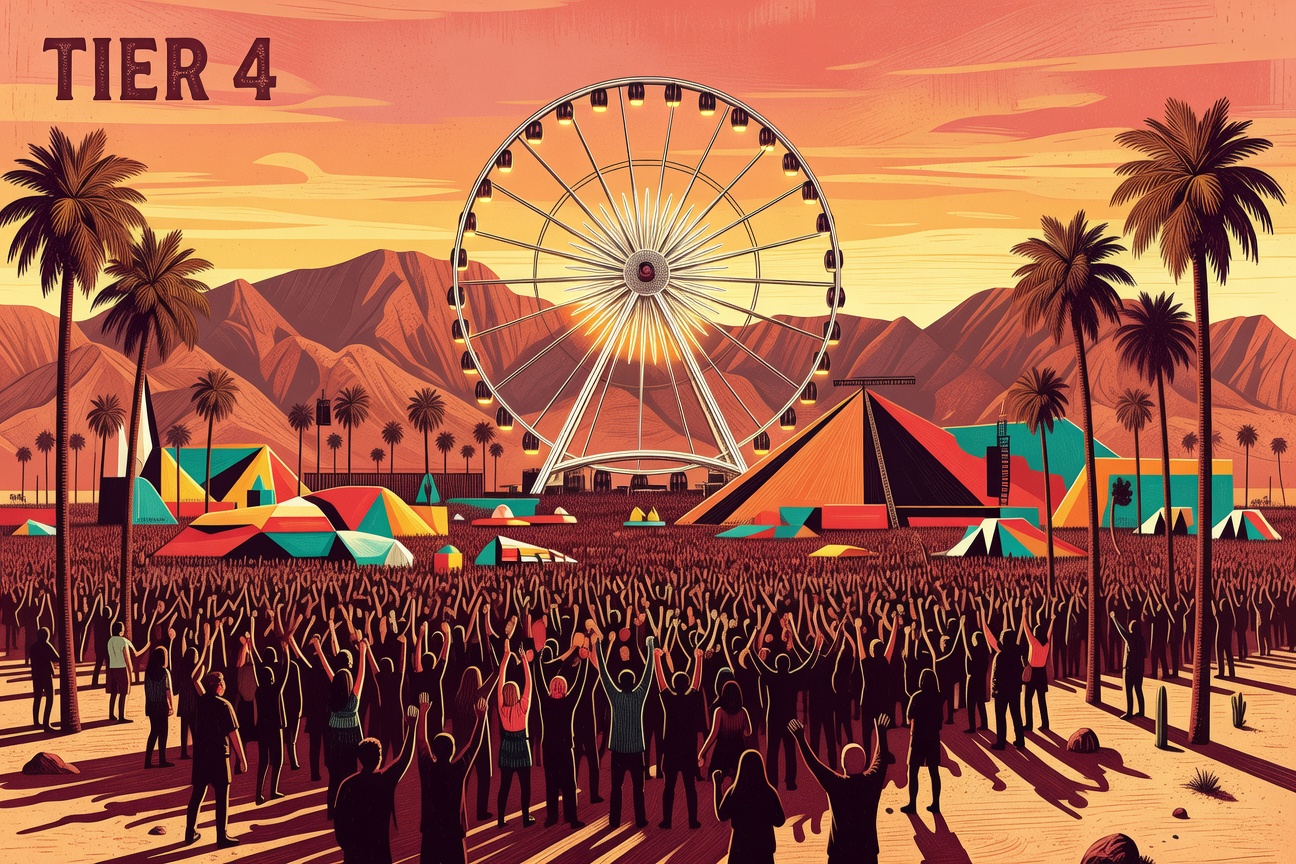
What it is: The big ones. 80,000-125,000 people. Multiple stages across a massive venue. Camping for 3-4 nights. The full sensory, social, and physical experience turned up to maximum. This is what people mean when they say "I went to a festival," and it's where the preparation from the first three tiers either pays off or reveals its gaps.
What you're learning: How to handle genuine overwhelm -- not just discomfort, but the feeling of being a small organism inside a massive, chaotic, beautiful, exhausting machine that doesn't slow down because you need a break. How to maintain boundaries in an environment that's designed to dissolve them. How to take care of yourself when nobody is going to do it for you. How to find your own pace in a sea of people running at maximum intensity for 72 straight hours.
The Culture Shift
Everything about Tier 4 is bigger, louder, longer, and more intense than what came before. But the real difference isn't scale -- it's norms. The social rules that govern daily life relax at major festivals. Things that would be unusual or unacceptable in your neighborhood, at your office, or at a restaurant are completely normal here. If you're prepared for this, it's liberating. If you're not, it's overwhelming.
Substances are visible and pervasive. Not hidden. Not whispered about. Open. People will be smoking, eating, drinking, and ingesting things around you constantly. Some of it is legal (alcohol, cannabis in legal states). Some of it isn't. People will offer you things. Not aggressively -- festival culture is generally respectful of "no" -- but casually, the way someone might offer you a chip at a party. You need to have your answer ready and be comfortable delivering it. "No thanks" is a complete sentence. Rehearse it before you go. The pressure doesn't come from other people -- it comes from your own desire to fit in. Know your lines before the curtain goes up.
Bodies are everywhere in various states of dress. Body paint as clothing. Mesh tops with nothing underneath. Underwear as outerwear. Full nudity at some events. This is not exhibitionism or a malfunction -- it's the culture. The festival is 100F during the day and people dress (or undress) for the heat and for self-expression. You get used to it faster than you'd expect. By day 2 you stop noticing. If you're someone who's uncomfortable with nudity, this is worth knowing in advance so you can mentally prepare rather than being blindsided.
You will see people having sex. In tents with the flap open. Behind art installations. In the general vicinity of other humans. This is not constant, but it happens, and if it's your first time encountering it in a semi-public context, it can be jarring. It's more common at night and in camping areas. By day 3 of a major festival, you'll be stepping around a couple making out on a blanket to get to the bathroom and checking your phone while you do it. Your brain normalizes faster than you think. But the first encounter can freeze you if you weren't expecting it.
You will see people at their worst. Bad drug experiences, alcohol poisoning, dehydration collapses, emotional breakdowns, heatstroke. Know where the medical tent is before you need it. If someone looks like they need help -- unresponsive, overheating, confused, scared -- find a medic. You are not qualified to handle a stranger's drug experience, but you can point a professional toward them. Most festivals have trained medical teams roaming the grounds specifically for this.
Time dissolves. By day 3, you won't know what day it is. Meals happen randomly. Sleep happens whenever. Your phone might die and you won't notice for hours. The festival has its own gravity and its own clock. This is either terrifying or liberating depending on how well the first three tiers prepared you.
Coachella Specifically
Dates: Two weekends in April (2026: April 10-12 and April 17-19)
Location: Empire Polo Club, Indio, CA
Attendance: ~125,000 per day
From Chandler: 4 hours via I-10 West
Cost breakdown:
| Item | Cost |
|---|
| GA pass | $429 + fees |
| Car camping | ~$180 ($40/night + tax) |
| Powered car camping | ~$200 |
| Parking spot size | 30 x 10 feet (car + tent must fit) |
| La Campana glamping | ~$2,600 (for those who want AC and a real bed) |
| Food on-site (3 days) | $120-180 |
| Total budget camping | ~$750-900 per person |
Weekend 2 is the move for first-timers. Slightly less crowded, slightly cheaper resale tickets, and the first-weekend veterans have already posted all the logistics tips, surprise guest reveals, and campsite hacks you can learn from. The FOMO of missing Weekend 1 is not real. The music is identical.
Car camping is the default Coachella experience. Your 30x10 foot plot fits your car and your tent. That's tight. A pop-up canopy overhangs into the shared lane, which is technically not allowed but universally done. Bring everything you'd bring for a Tier 3 camping festival, plus extra water (Indio in April is 90-100F), extra shade, and a portable phone charger with at least 3 full charges.
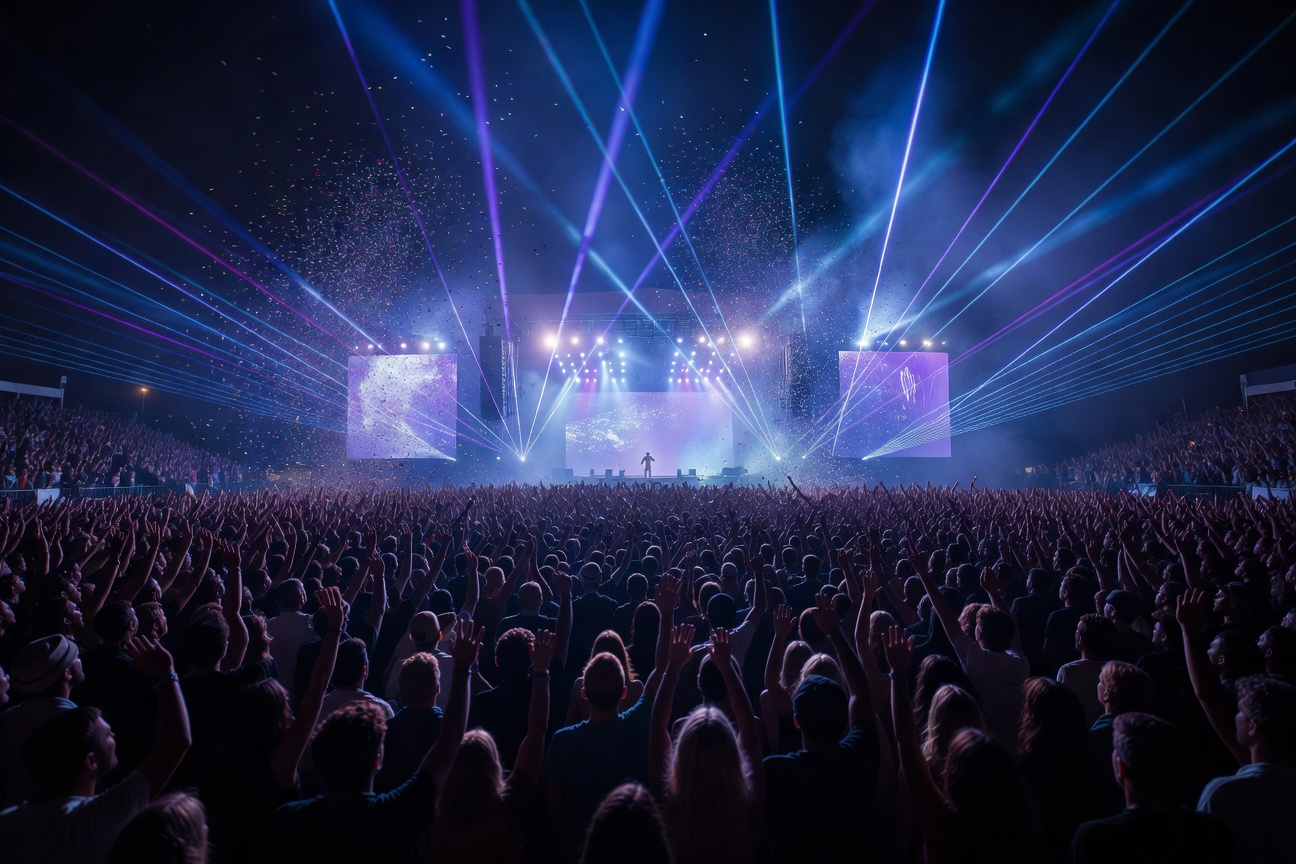
Other Tier 4 Options
Bonnaroo (Manchester, TN, June) -- The community-focused counterpart to Coachella. Camping is the default, not the option. The crowd skews friendlier and more communal than Coachella's social-media-forward atmosphere. "Radiate positivity" is the slogan and the culture mostly lives up to it. Southern June heat is brutal and humid (very different from dry Arizona heat). Four days. ~$350-400 GA.
Electric Forest (Rothbury, MI, June) -- Set in an actual forest with art installations woven through the trees. The most visually magical of the major festivals. Camping is under a tree canopy, which helps with heat but creates its own atmosphere (bugs, uneven ground, rain risk). Electronic and jam band focused. ~$350 GA.
You're Ready for Tier 5 When
- You've done a 3-4 night camping festival and wanted more, not less
- You've maintained your physical health through an entire multi-day event (no heatstroke, no dehydration, no injury)
- You can pack for a festival in under an hour from a practiced checklist
- You're genuinely comfortable being uncomfortable -- heat, noise, crowds, strangers, porta-potties, sleep deprivation
- You've experienced the full spectrum of festival humanity -- the beauty and the mess -- and you still want to be part of it
- You've taken care of someone else at a festival: given water to a stranger, helped find a medic, walked someone back to their camp. You've gone from consumer to community member.
- You understand in your bones that the festival doesn't owe you anything. Your experience is your responsibility.
Tier 5: Radical Self-Reliance
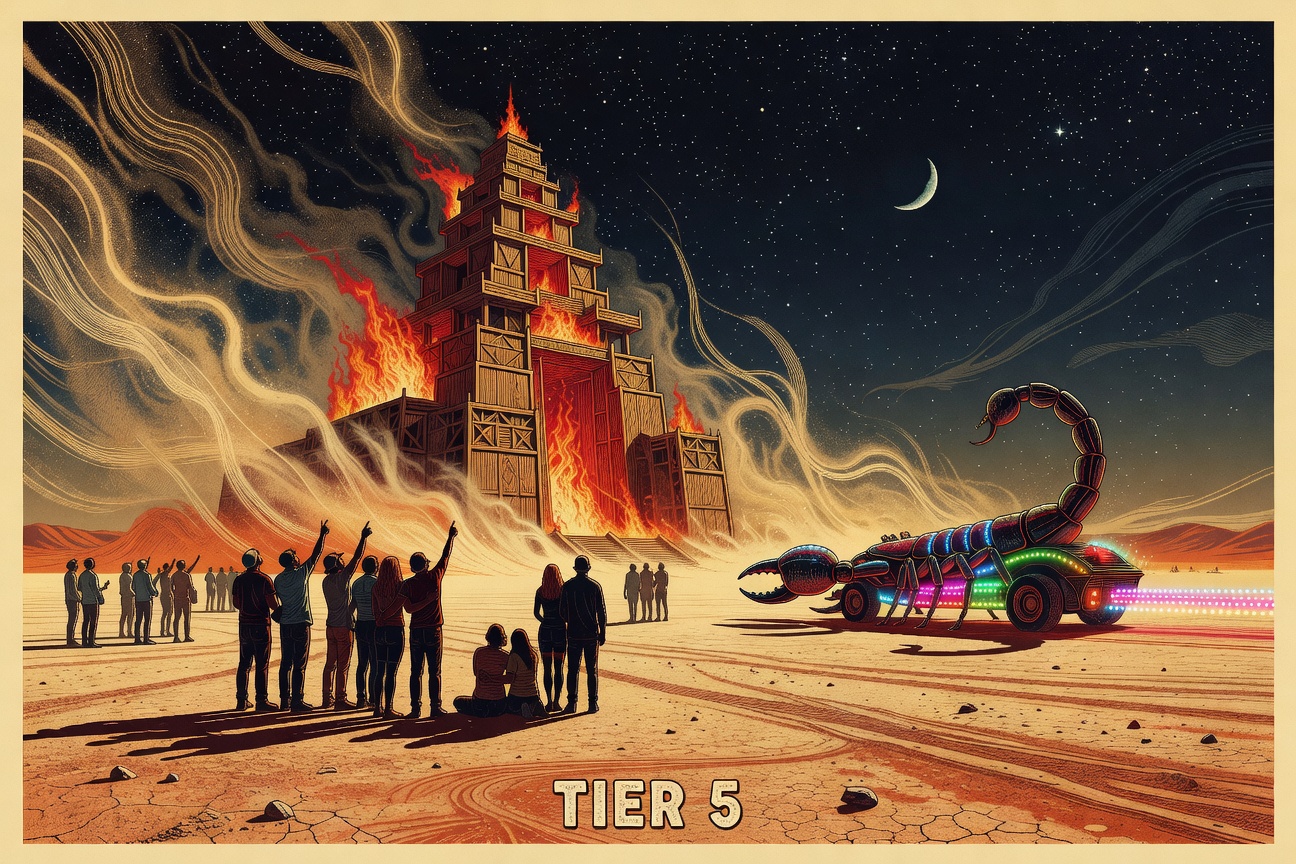
What it is: Burning Man and events modeled on its principles. The rules change completely. There are no vendors. There's nothing to buy. No food stands, no lemonade carts, no merchandise tents. You bring every calorie, every gallon of water, every item you need to survive for a week in a flat, white, alkaline desert that is actively hostile to human comfort. The event is not something you attend -- it's something you participate in and contribute to. If you show up as a consumer expecting to be entertained, you will have one of the worst weeks of your life.
Burning Man: The Real Numbers
Dates (2026): August 30 through September 6 (Sunday to Sunday)
Location: Black Rock Desert, Nevada -- a dry lakebed called the "playa" that is flat, featureless, and covered in fine alkaline dust
Attendance: ~70,000 people building a temporary city called Black Rock City
From Chandler: 12-hour drive minimum. Plan for 15+ hours including the entry line, which can be 4-8 hours on peak arrival days.
Theme (2026): Axis Mundi
Water: 1.5 gallons per person per day is the minimum for drinking alone. But you also need water for cooking, washing dishes, basic hygiene (rinsing dust off your face, brushing teeth, cleaning wounds), and gray water for any cleanup. The real number is 2.5 gallons per person per day when you account for everything. For 8 days, that's 20 gallons per person. For two people: 40 gallons. That's over 300 pounds of water, plus the containers to carry it. If you're very active and the temperature exceeds 100F (it will on several days), push to 3 gallons. There is no water for sale on the playa. If you run out, you are dependent on the generosity of neighbors or the medical team. Do not be that person. Over-pack water. You can always bring extra home. You cannot conjure it in the desert.
Ice: The only thing commercially available at Burning Man. Arctica sells it at three locations on the playa. Crushed ice: $10 for 16 lbs. Block ice: $5 for 10 lbs. Lines can be 30-60 minutes during peak hours. Bring coolers with good insulation and pre-freeze water bottles before you arrive.
Food: All of it. For a week. Shelf-stable snacks (trail mix, jerky, crackers, peanut butter), canned goods, fresh fruit that can survive heat (oranges, apples), and whatever you can cook on a camp stove. No restaurants. No delivery apps. No running to 7-Eleven. If you didn't pack it, you don't eat it (unless a camp gifts you something, which happens, but you cannot plan around generosity).
Budget (first-time Burner, per person):
| Item | Cost |
|---|
| Ticket | $575 (face value, with fees closer to $650) |
| Vehicle pass | $140 |
| Gas/charging (Phoenix to BRC round trip, ~1,400 miles) | $60-100 |
| Water (12+ gallons) | $15-25 |
| Food (8 days of provisions) | $100-200 |
| Ice (buying every other day) | $30-50 |
| Gear (shade structure, goggles, dust mask, lights, camp gear) | $300-800 first time |
| Costumes and gifts | $50-200 |
| Total first Burn | $1,250-2,200 |
The Vehicle Problem
Do not bring a nice car to Burning Man. The alkaline playa dust is not regular dirt. It's a fine, corrosive powder that infiltrates every seal, vent, bearing, and electronic component in your vehicle. People who bring their daily drivers spend months trying to clean it out afterward, and some damage (corroded rubber seals, HVAC systems packed with dust) is permanent. An EV like a Tesla is especially wrong for this: no Superchargers anywhere near Black Rock Desert (closest is Reno, 120 miles south), no towing capacity for water and gear, and no ground clearance for the rutted dirt entry road.
Rent a truck. A full-size pickup (F-150, Tundra, Silverado) or SUV (Suburban, Tahoe) from Enterprise or a similar agency runs $500-800 for the week. The truck bed carries your water jugs, shade structure, and gear. The cab sleeps in a pinch. The ground clearance handles the playa. And when you return it covered in dust, that's Enterprise's problem, not yours.
Some veteran Burners buy a dedicated "$3,000 Craigslist truck" specifically for Burns and sell it after. If you plan to go more than once, this math works out: two years of rentals costs more than a beater truck you own.
Water transport: At 40+ gallons for two people, you need 6-8 five-gallon jerry cans or a couple of large water containers. These go in the truck bed. A sedan physically cannot fit a week's water supply plus camping gear plus food plus costumes plus shade structure. This is why Burning Man is a truck-and-trailer event, not a road-trip-in-the-sedan event.
What Makes It Different From Everything Before
Every tier until now had infrastructure. Porta-potties were gross but they existed. Water was expensive but available. Food could be purchased. Someone else set up the stages, ran the sound, and kept the lights on. Burning Man removes all of that except the porta-potties (which they provide and service -- one of the few things the organization handles centrally).
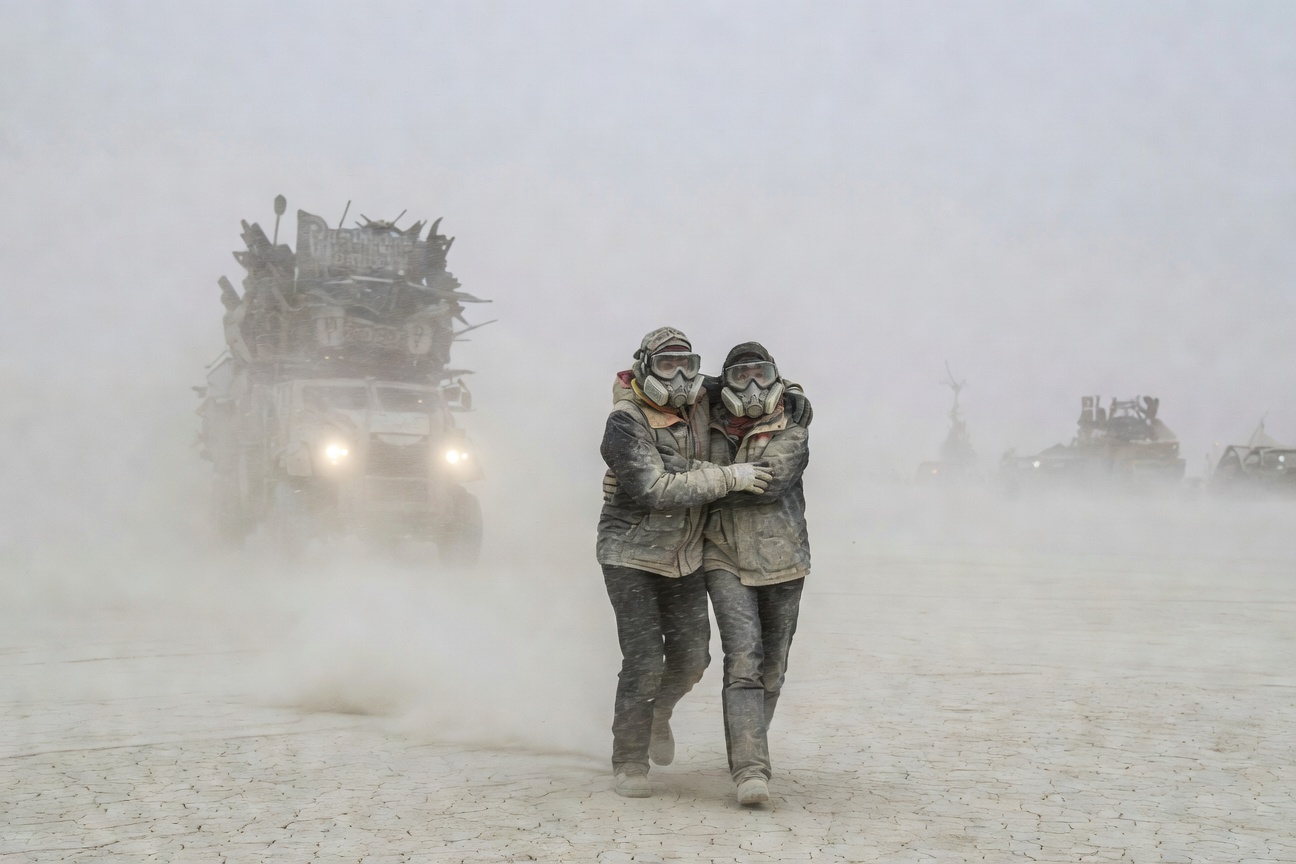
Dust. The playa dust is not dirt. It's alkaline, fine as talcum powder, and it infiltrates everything. Your camera, your lungs, your breakfast, your hair, your relationships. It doesn't wash off with water alone -- it requires vinegar or a dedicated playa-dust soap. You need goggles (not sunglasses) and a dust mask or bandana for whiteout dust storms where visibility drops to three feet. These storms can last 20 minutes or 6 hours. You cannot predict them. When one hits, you stop moving and wait.
The 10 Principles. Burning Man operates on ten guiding principles: radical inclusion, gifting, decommodification, radical self-reliance, radical self-expression, communal effort, civic responsibility, leaving no trace, participation, and immediacy. These aren't suggestions. They're the social contract. Decommodification means no branding, no advertising, no selling. Gifting means you offer things to others without expecting anything in return. Radical self-reliance means nobody is coming to save you. Leave no trace means when you leave, there should be zero evidence you were there -- every scrap of trash, every drop of gray water, every misplaced sequin. This is enforced and inspected.
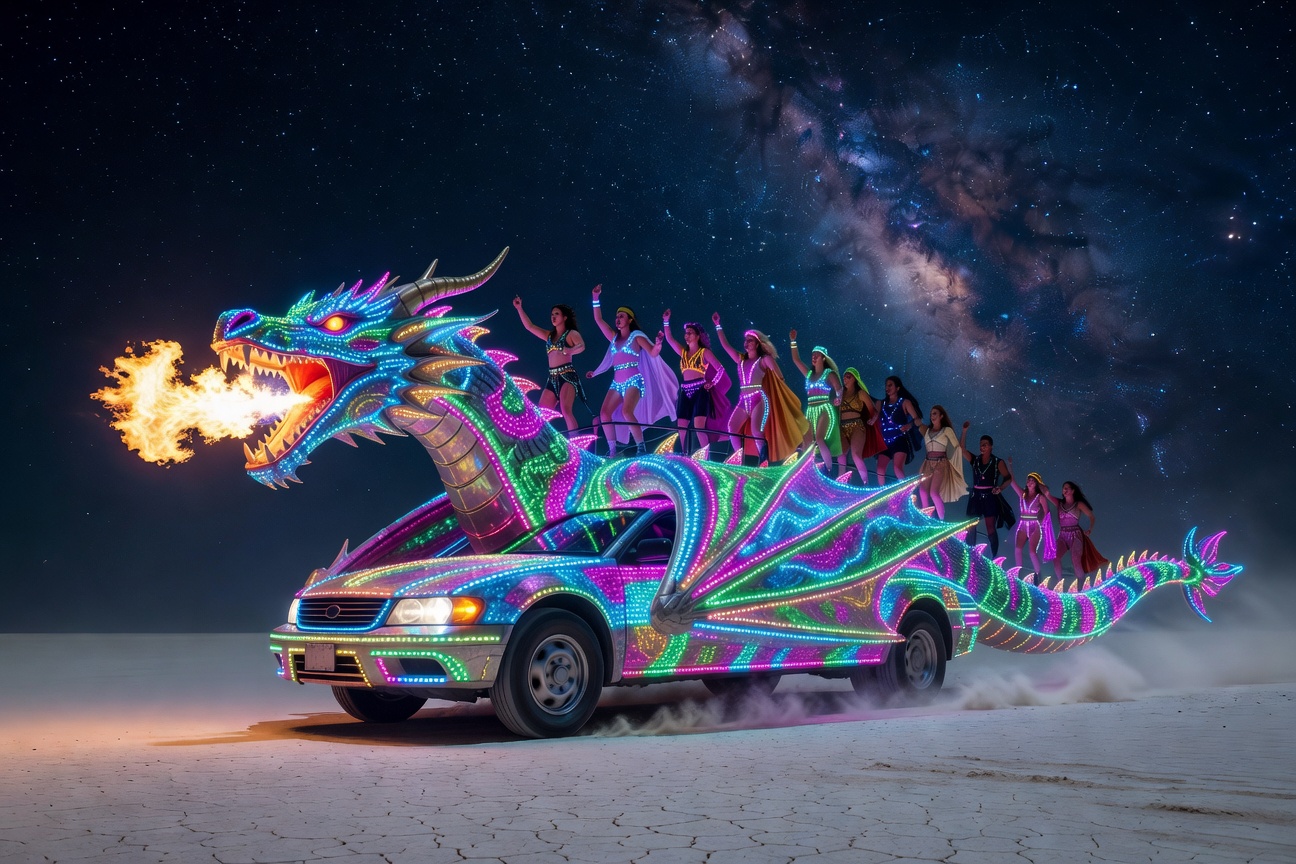
The art. This is the reason people endure everything else. Massive sculptures that dwarf buildings. Interactive installations you climb, crawl through, and play on. Mutant vehicles -- art cars shaped like dragons, ships, insects, and things that defy description -- roaming the playa at night with sound systems and LED lights. Fire performances. Participatory theater. And the Temple -- a massive structure built for the community to leave messages of grief, hope, loss, and gratitude, which burns on the last night in a ceremony of collective silence. It is one of the most moving human experiences you can have, and it exists only because 70,000 people agreed to build a city in the desert for one week and then erase it completely.
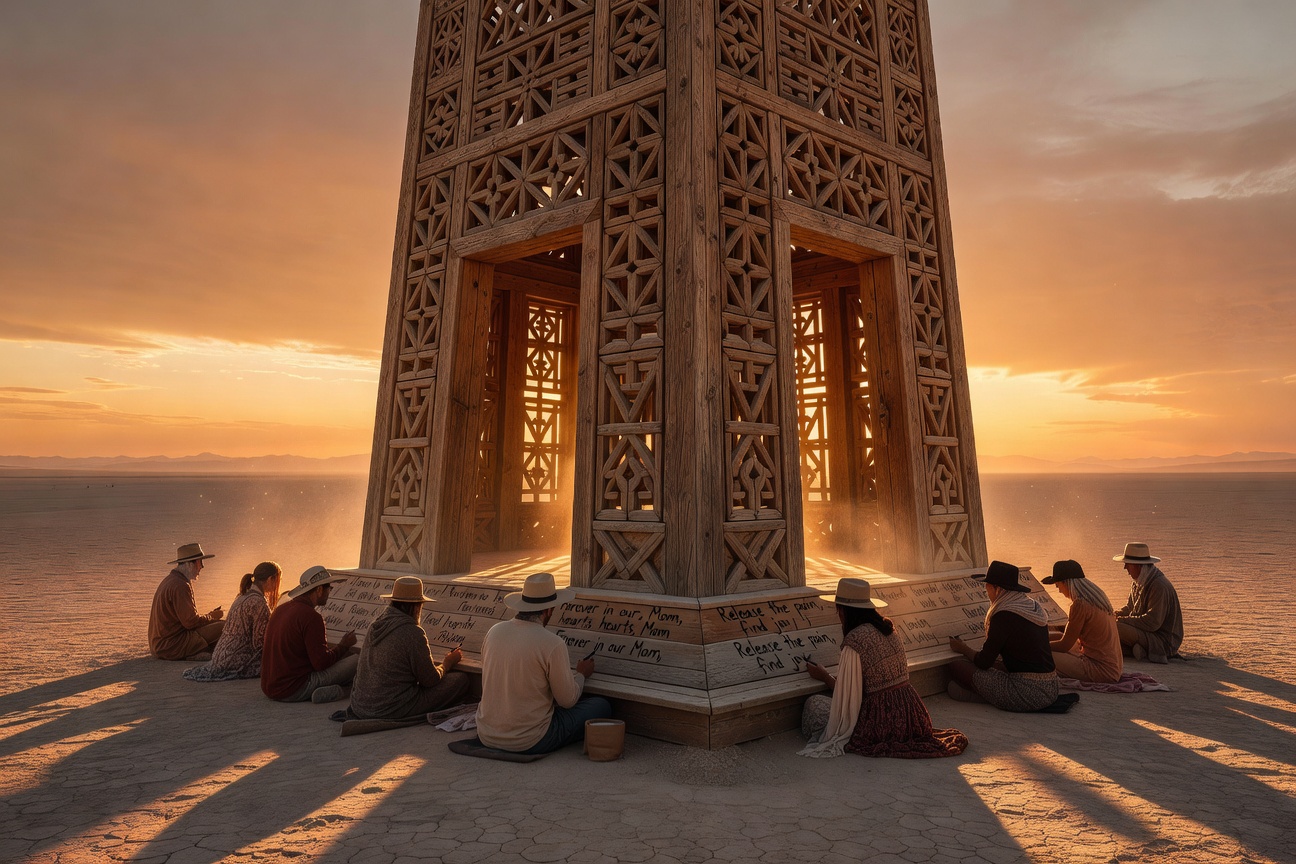
Camps. You don't just set up a tent. You join or create a theme camp that contributes something to the city. A bar that serves free cocktails. A pancake breakfast. A massage tent. A DJ booth. A workshop where people learn to weld. A hammock garden. Participation is the currency. You are expected to give, not just take. Finding a camp to join is part of the 6-month preparation process.
The Preparation Timeline
Burning Man preparation starts 6 months before the event. This is not an exaggeration. People who treat it like a last-minute camping trip suffer.
6 months out: Join the community. Reddit r/BurningMan, ePlaya forums, Phoenix Decompression (the local Burner group). Read the survival guide on the Burning Man website. Start understanding the culture before you buy a ticket.
4 months out: Attend a regional burn. These are smaller, local versions of Burning Man that follow the same principles. Arizona has Saguaro Man and Scorched Nuts. Same values, smaller scale, closer to home (2-4 hours from Chandler). If you hate the regional, you'll hate the main event, and you just saved yourself $2,000 and a week of suffering.
3 months out: Build your gear. Not all at once. Start with a shade structure (this is the most critical piece -- a 10x10 or larger canopy that creates a livable space in 100F+ heat). Add a quality tent, sleeping setup, coolers, camp stove, lighting, and dust-mitigation gear over the next weeks.
2 months out: Join a camp officially. They'll have a packing list, a contribution expectation, and people who've done this before. Listen to them.
1 month out: Physical preparation. Walk 5+ miles daily. The playa is walking. All day. In heat. In dust. Cardio and heat acclimation matter. If you live in Arizona, you have a natural advantage -- use it.
1 week out: Final pack. Test every piece of gear. Freeze water bottles. Load the car. Accept that you've forgotten something and it'll be fine.
You're Ready for Burning Man When
- You've completed tiers 1-4 and genuinely enjoyed the camping festival experience (not just tolerated it)
- You've attended a regional burn (Saguaro Man or equivalent) and understood the culture from the inside
- You can be entirely self-sufficient for 72 hours in the desert with only what you brought
- You have a camp to join, people to go with, and something to contribute
- You understand that this is not a music festival, not a party, not a vacation -- it's a temporary city experiment built on participation and gifting
- You're going because you want to give something, not because you want to take a photo
The 2-Year Timeline
A realistic progression from zero to "whatever you want" starting from scratch. This assumes you're based in Arizona and can access the festivals listed above.
Year 1: Foundation
| When | What | Tier | Cost |
|---|
| Spring Y1 | 2-3 local day festivals (First Friday, Ostrich Fest, VIVA PHX) | 1 | $50-150 total |
| Summer Y1 | Survive an outdoor event in 100F+ (heat acclimation) | 1 | $20-50 |
| Fall Y1 | Multi-day event (Innings, or a concert weekend in another city) | 2 | $400-700 |
| Winter Y1 | Research camping gear, start buying basics (tent, sleeping pad, canopy) | -- | $200-400 |
Year 2: Escalation
| When | What | Tier | Cost |
|---|
| Spring Y2 | Camping festival (Country Thunder or Stagecoach) | 3 | $500-900 |
| Summer Y2 | Regional burn (Saguaro Man) if Burning Man is the goal | 3.5 | $200-400 |
| Fall Y2 | Debrief. Honest self-assessment. Continue or stop. | -- | $0 |
Year 3: The Deep End (If You Want It)
| When | What | Tier | Cost |
|---|
| Spring Y3 | Coachella or Bonnaroo | 4 | $750-1,200 |
| Late Summer Y3 | Burning Man (if the path led here) | 5 | $1,250-2,200 |
The most important row is Fall of Year 2. If camping festivals aren't for you, that's the answer. Tier 2 is a perfectly great place to live forever. Hotel sleeping, real showers, incredible music, and you drive home to your own bed. There is no shame, no failure, and no "missing out" in knowing your limits. The person who happily attends Innings Festival every February and sleeps in a Tempe hotel is having exactly as valid a festival experience as the person at Burning Man. The only wrong answer is pushing past your comfort zone out of peer pressure rather than genuine desire.
Universal Rules
These apply at every tier, every festival, every time:
- Hydrate before you're thirsty. If you feel thirst, you're already behind. Drink water constantly. Add electrolytes in any heat above 85F.
- Eat real meals. Festival food is fun but it's not fuel. Eat protein. Eat breakfast before you go out. Your body is an endurance machine at a festival -- feed it like one.
- Sunscreen is non-negotiable. SPF 50 minimum. Reapply every 90 minutes. Get the back of your neck, your ears, your part line, and the tops of your feet if you're wearing sandals. A sunburn on day 1 ruins the other 2-6 days.
- Comfortable shoes over cute shoes. Every time. No exceptions. You will walk 10-20 miles in a weekend.
- Buddy system. Agree on a meeting point before you enter. Share live location with your group. Set check-in times. Dead phones kill the buddy system, so bring a charger and designate a physical backup meeting spot.
- "No" is a complete sentence. Substances, situations, invitations, conversations. If you're not into it, decline. Nobody at a festival worth attending will pressure you past one ask.
- Earplugs save your hearing. Tinnitus is permanent and cumulative. Concert earplugs are $30. The math is not complicated.
- Leave it better than you found it. Pick up your trash. Pick up trash that isn't yours. This is the minimum standard of being a decent festival human.
- Know where medical is. Before you need it. Before your friend needs it. Before the stranger on the ground needs it. Walk past the medical tent on your first lap so you know where it is.
- It's OK to leave. If you're overwhelmed, dehydrated, anxious, overstimulated, or just done -- go. Back to camp. Back to the hotel. Home. No festival is worth your health, your safety, or your peace of mind. You can always come back next year with better preparation and a clearer sense of what you want from the experience.